Why One Successor Is Rarely Enough
Founder dependency is often the result of founder excellence. The objective of succession should not be to find another indispensable individual. It should be to build an organisation that no longer depends on one.
Walk through a successful industrial business in the Alpine region and the founder’s influence may not be immediately obvious.
There may be an experienced management team, capable engineers, longstanding customer relationships and established operating processes. The company is profitable, respected and technically accomplished. On paper, it does not appear to depend on any one person.
Then an important customer raises an unusual concern. A critical supplier misses a deadline. A senior employee considers leaving. A new product requires an investment decision. In each case, the organisation turns, formally or informally, to the founder.
After thirty or forty years, the founder knows which customer is genuinely concerned and which is simply negotiating. They know which technical compromise is acceptable, which employee is ready for greater responsibility and which supplier will find a solution when something goes wrong. They remember the investments that succeeded, the opportunities that proved distracting and the decisions that shaped the company’s reputation.
Much of this knowledge has never been written down because the founder has never needed to write it down.
The business may employ a hundred people. Part of its operating system still lives inside one.
Why founder dependency develops
Founder dependency is often described as a weakness. It can become a serious risk when decisions, relationships and technical knowledge remain concentrated in one person, but calling it only a weakness misses how it developed.
The founder became central because their judgement was consistently good. Customers learned to trust them. Employees relied on them for difficult decisions. Suppliers knew they would stand behind their commitments. Over decades, they proved that they could see across the whole business and act in its long-term interest.
The company was not built incorrectly. A centralised model may have allowed it to move quickly, maintain high standards and make difficult decisions during its formative years because an unusually capable person stood at the centre of it.
The problem is timing, not judgement.
The system that helped build the business over its first thirty years may not be the right system for its next thirty. The founder’s greatest strength can gradually become the company’s greatest dependency.
A founder is not one job
In an established industrial business, the founder is often far more than the chief executive.
They may also be the principal shareholder, senior salesperson, capital allocator, technical arbiter and cultural reference point. Important customer relationships sit with them. Employees look to them when a difficult decision has to be made. Years of operational judgement influence choices that may never have been written down.
These responsibilities were not designed as a formal job description. They accumulated over decades as the founder responded to customers, solved problems and built the company.
This is why the search for a single replacement can be misleading. The title may pass to one person, but the founder’s contribution cannot be reduced to a title.
The best successor to an exceptional founder is not another exceptional person on whom the company becomes equally dependent. It is an organisation capable of succeeding without one.
Succession involves five different transfers
A change of ownership may take place on a particular day. Succession is broader. It involves five connected transfers, each of which moves at a different pace.
Ownership is the transfer of the legal and economic responsibility for the business to a committed long-term ownership structure.
Executive authority is the transfer of decision-making to a capable leadership team with clear responsibilities and accountability.
Institutional knowledge is the movement of technical understanding, operating judgement and organisational memory from the founder into people, systems and shared ways of working.
Stakeholder trust is the extension of important customer, supplier, employee and adviser relationships beyond the founder.
Cultural legitimacy is earned when the next generation of leaders demonstrates that it understands what should be preserved, what can develop and why the distinction matters.
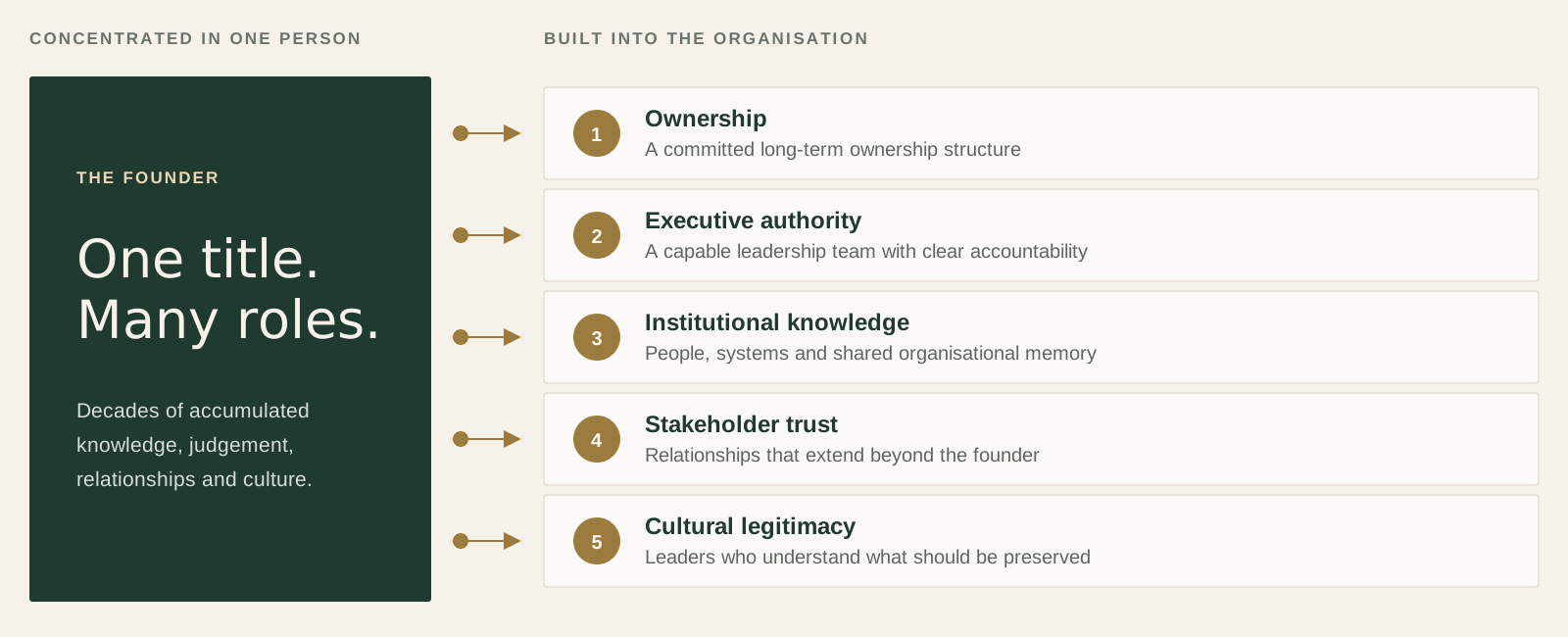
These transfers do not move at the same speed. A complementary team creates the capacity to advance several of them in parallel while the business continues to operate and grow.
Ownership can transfer in a day. Succession cannot
A transaction creates a clear point in time. Documents are signed, consideration changes hands and legal control moves from one shareholder to another. It is easy to mistake that moment for the completion of succession.
It is not.
These transitions do not happen on the same timetable.
Customers may continue calling the founder long after a transaction closes. Employees may still look to them for reassurance. The new owner may hold formal authority while having limited understanding of why the business operates as it does. Important relationships may remain personal rather than becoming institutional.
A transaction can transfer shares. It cannot transfer trust, judgement or legitimacy on the same day. Those must be earned.
Some responsibilities can move before ownership changes. Others require a defined period of cooperation afterwards. What matters is that each transition is deliberate and that employees, customers and advisers understand who is responsible for what.
Institutional knowledge cannot simply be downloaded
Some founder knowledge can be documented. Contracts, processes, customer histories, technical specifications and financial information can all be recorded and organised.
The most valuable knowledge is often harder to capture.
It includes judgement built through repeated experience, relationships earned through years of reliability and an intuitive understanding of how the organisation behaves under pressure. It also includes the history behind decisions: why a market was avoided, why a product was discontinued, why an apparently inefficient process matters or why one longstanding customer needs to be handled differently from the rest.
Research has long recognised the importance of this knowledge. A study published in Family Business Review identified a successor’s ability to acquire the predecessor’s knowledge and skills as central to maintaining and improving the performance of a family firm.
Recent evidence from the Alpine region reaches a similar conclusion. A 2026 study by UBS and the Center for Family Business at the University of St. Gallen surveyed Swiss SME owners who had completed a succession. It found that 60% considered knowledge transfer from their predecessor decisive to the success of the transition. Among management buyouts, the figure rose to 73%.
Knowledge transfer is not an administrative step added to the end of a transaction. It is one of the central tasks of succession.
It is also unlikely ever to be complete. No successor can recreate the founder’s thirty or forty years of experience. The goal is not to replicate everything the founder knows. It is to determine what must be transferred, what should be embedded in the organisation and what may no longer matter to the company’s future.
A team creates a higher-capacity transition
A single successor must absorb the founder’s knowledge while also running the company.
They need to understand customers, earn the confidence of employees, learn the operational realities of the business, work with advisers and lenders, assess the existing management team and begin making decisions about the future.
These demands do not arrive one at a time.
An aligned team creates greater capacity. Different people can work alongside the founder across different parts of the business at the same time. One may focus on customers and commercial development, another on leadership and organisational capability, and another on capital allocation, governance and the ownership transition.
The founder remains the common source of knowledge, but the transfer no longer depends on one person mastering every dimension in sequence.
This does not necessarily make the transition shorter. A thoughtful succession should usually take time. What a team changes is how effectively that time can be used.
A team can absorb more knowledge, transfer more relationships and give proper attention to more of the business. The company does not have to choose between protecting what already works and preparing for what comes next.
One part of the team can help hold the foundations steady. Another can strengthen the organisation beyond the founder. A third can consider where the company might extend its reach.
A team is only stronger when it is aligned
More people are not automatically better.
A poorly aligned team can be worse than one capable successor. It can create politics, inconsistent messages, slower decisions and competition for influence.
Complementary expertise without alignment produces complexity, not strength.
A succession team creates value only when its members share the same objective, trust one another and understand who is accountable for what.
Employees, customers and advisers cannot receive different answers from different members of the incoming group. The business should not exchange one dominant founder for a committee in which nobody is clearly responsible.
The University of St. Gallen study supports this point. Among the owners surveyed, 93% identified clear roles and responsibilities as an important success factor, while 85% pointed to regular communication.
The strongest succession teams share a long-term horizon, agree on what should be protected and have clearly defined decision rights. Their capabilities are genuinely complementary rather than duplicated.
They can disagree honestly while still giving the organisation one coherent message. There is no internal contest to become the new founder.
This structure still requires clear leadership and personal accountability. The team adds breadth around the leader. It does not replace leadership with consensus.
Not everything should remain unchanged
A founder’s experience is enormously valuable, but thirty years of experience also produces habits, assumptions and preferences. Some remain essential. Others reflect circumstances that no longer exist.
A market that appeared unattractive ten years ago may be accessible today. A product once considered too risky may now be technically viable. An informal practice that worked with twenty employees may become a constraint when the company employs a hundred.
Thoughtful succession distinguishes between four things:
- Knowledge that must be transferred
- Values that should be protected
- Capabilities that should be strengthened
- Practices that should be reconsidered
The same logic applies to culture.
Culture does not live in a mission statement. It appears in how decisions are made, how customers are treated, what standards are expected and what behaviour is rewarded.
A new owner cannot preserve culture by imitating the founder. Trying to keep it entirely unchanged is also unrealistic. Culture will evolve whenever leadership, ownership or strategy changes.
The real choice is not between changing the culture and preserving it. It is between allowing it to evolve deliberately and allowing it to drift by accident.
Stewardship does not mean preserving every decision the founder ever made. It means understanding why those decisions worked and recognising when the circumstances behind them have changed.
International experience should be translated, not transplanted
International experience can help an incoming team see a wider range of possibilities.
People who have worked across different countries and operating environments have usually encountered different routes to market, governance structures, customer expectations and approaches to growth. This can improve pattern recognition and help the company evaluate possibilities beyond its existing frame of reference.
Research among Canadian software-product SMEs found that internationally experienced management teams were more likely to develop foreign strategic partnerships and reached foreign sales sooner. The sector and geography are different, but the underlying principle is relevant: experience across markets can widen the range of opportunities a leadership team is able to recognise.
International experience can also become a liability.
Executives sometimes arrive with a familiar playbook and assume that what worked elsewhere will work again. In doing so, they risk underestimating local relationships, technical traditions and the quiet strengths that made the company successful in the first place.
International experience creates value when it sharpens judgement. It destroys value when it becomes an excuse to import solutions without understanding the circumstances.
An Alpine industrial business should remain rooted in its people, customers and industrial heritage. The team’s role is to widen what the company can see, not to replace what made it exceptional.
The transition should create options for the founder
Preparing a company to operate beyond its founder does not mean forcing the founder to leave sooner. It means giving them more choice.
A business with deeper management, broader relationships and less reliance on one person allows the founder to decide where they still want to contribute.
They may remain close to a small number of important customers, move into a chair or advisory role, support technical development or step away entirely.
Their involvement becomes a choice rather than a condition on which the company depends.
This also strengthens the company ahead of an ownership transition. A business that can operate independently of its founder is easier for a new owner to understand, support and build upon. Employees, customers and advisers can have greater confidence that responsibilities and relationships will not be left unresolved.
The goal is not to remove the founder. It is to remove the obligation for them to stay.
The real successor is the organisation
A successful founder spends decades learning to manage every important responsibility in the business.
The next generation of ownership should not require another individual to become exactly the same kind of juggler. Replacing one indispensable person with another is not a complete succession. It is a renewal of the same dependency.
The better objective is an organisation in which knowledge, relationships and responsibility are shared more deliberately.
The founder’s experience is transferred rather than lost. Culture evolves consciously rather than by accident. Clear authority replaces informal dependence. The company continues performing while developing the capabilities required for its next stage.
One person may succeed the founder in title. A complementary team may lead the transition. But the real successor should be the organisation itself.
At Graculus, this belief sits at the centre of our approach. We do not expect one person to replace an exceptional founder. We bring together complementary capabilities around one cornerstone business, with the objective of protecting what made it exceptional and building an organisation capable of carrying it forward.
Gerhard Botha, Co-Founder, Investment, Finance & Governance, Graculus Industries
Gerhard has more than two decades of experience across professional services, investment banking, private capital and company building. He spent four years at PwC before 12 years at RMB, where he advised on more than $8 billion of completed transactions across Europe, the Middle East, Africa and Asia and established the firm’s Private Capital Advisory business. Alongside his advisory career, he co-founded and helped build technology businesses, including Gyzer Networks, a payments platform that was later acquired by a US public company.
Sources
- UBS and Center for Family Business, University of St. Gallen, Understanding Business Succession as a Process, 2026.
- Cabrera-Suárez, De Saá-Pérez and García-Almeida, The Succession Process from a Resource- and Knowledge-Based View of the Family Firm, Family Business Review, 2001.
- Reuber and Fischer, The Influence of the Management Team’s International Experience on the Internationalization Behaviors of SMEs, Journal of International Business Studies, 1997.